
A buyer’s guide for municipalities, BIDs, and shopping centers sourcing commercial Christmas decorations and commercial holiday decoration services.
You’ve been burned before. Maybe not you personally, but if you’ve sat through a vendor selection process for your municipality, BID, shopping center, or other commercial space, you’ve heard the stories: displays that arrived late, installation crews that never showed up on time, or a “quick fix” request that took three weeks and five phone calls to resolve. Industry research consistently points to one factor as the top reason buyers, whether municipalities, BIDs, or shopping centers, walk away from a vendor relationship: a past bad service experience. Not price. Not product selection. Service.
That matters because a commercial holiday display isn’t a one-time purchase. It’s a multi-year relationship involving design, manufacturing, delivery, installation, storage, and often takeoff and maintenance the following season. If the vendor relationship breaks down at any point in that cycle, you’re the one fielding calls from your community, your tenants, or your council when the lights don’t go up on time.
Here’s what to watch for before you sign, and what a dependable vendor actually looks like.
Why Vendor Selection Carries More Risk Than It Seems
A commercial Christmas display involves a long list of moving parts: custom design work, manufacturing lead times, freight logistics, on-site installation, and (in many cases) a storage and maintenance agreement that spans into next season. Every one of those steps is a place where a vendor can under-deliver. And because holiday displays operate on a fixed calendar, there’s no room for delay. A tree that arrives in January instead of November isn’t a minor inconvenience. It’s a missed season.
That’s why the red flags below tend to show up long before installation day, if you know where to look.
Red Flags to Watch For
No Verifiable History of Commercial Decorating Services
Any vendor can show you a polished gallery of past installations. Fewer can point you to a current client willing to talk about their experience. If a vendor hesitates when you ask for references, or only offers testimonials pulled from their own website, treat that as a signal. Ask directly for a client in a similar-sized municipality or district and follow up with them.
Length of relationship is one of the clearest signals here. We’ve worked with Hersheypark for over 15 years, the City of Philadelphia and Manayunk’s Main Street for over 15 years, and Benderson Development’s Mall at University Town Center for over 13 years, along with a six-year partnership with the City of Bethlehem. A vendor doesn’t keep a client for over a decade by falling short on service.

Vague Timelines Without Accountability
Watch for language like “we’ll get it done in time for the season” without a specific production and delivery schedule attached. A vendor confident in their process will give you real dates: when design proofs are due, when manufacturing begins, when your display ships, and when installation crews are on-site. If those dates aren’t in writing, they aren’t commitments.
A dependable decorating process accounts for logistics before installation day ever arrives: confirming power requirements and locations, tailoring installation procedures to your specific site, and assigning decorators to supervise on-site so the design stays intact from proof to finished display. Materials also need somewhere to go afterward. Our storage facility is a Category 5-rated, 30,000-square-foot structure built to protect your investment between seasons.
Communication Gaps Before You’ve Even Signed
How a vendor communicates during the sales process is usually how they’ll communicate once you’re a customer. If it takes days to get a response to a simple question now, expect that same pattern (or worse) once you’re mid-installation, and something needs adjusting. Pay attention to whether you’re getting a single point of contact or bouncing between departments with no one taking ownership.
No Transparency Around Manufacturing
Where and how a product is made affects its durability, lead time, and your ability to get replacement parts years down the line. A vendor who can’t clearly explain their manufacturing process or is vague about sourcing is harder to hold accountable if something goes wrong with the décor itself.
Our own history is a good example of what to look for. HOD has been manufacturing commercial holiday decorations since 1921, growing over the past century into one of the largest distributors in the industry. That kind of longevity means manufacturing know-how consolidated under a single, accountable name instead of scattered across subcontractors.
Limited Support After Installation
The relationship shouldn’t end when the display goes up. Ask what happens if a strand goes out in week two of the season, or if a banner needs repair before takedown. A vendor without a clear plan for repairs and replacements after installation is telling you, in advance, what your experience will be like if anything goes wrong.
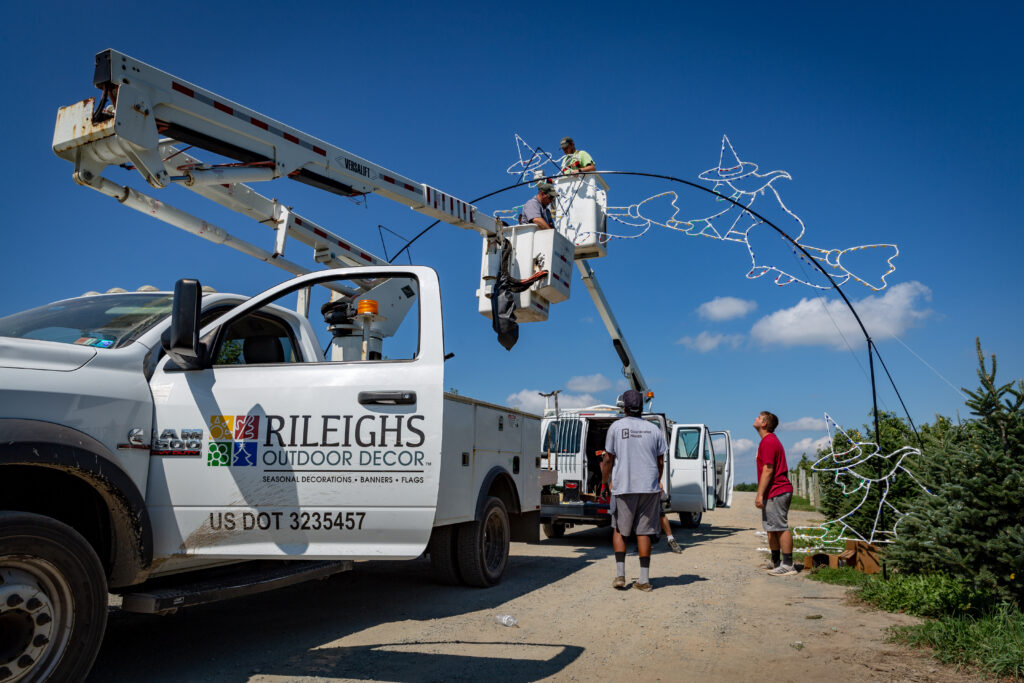
Our White Glove program keeps a standby emergency team, seven company-owned bucket trucks (with a fleet of 30+ in-season), and 40 decorators on the road throughout the season for exactly this reason. Displays are also stored for 11 months in climate-controlled facilities and refurbished before the next season begins, so you’re not troubleshooting a support gap on your own mid-season.
Pressure to Decide Quickly
Legitimate vendors understand that municipal and commercial budgets involve approval processes, board sign-offs, and multiple stakeholders. If you’re feeling pushed toward a same-week decision, that pressure is more about closing the sale than about serving your timeline.
What to Look for in a Vendor Instead
Use this as a quick checklist when you’re comparing vendors:
- A documented production and delivery timeline, with specific dates tied to your contract
- References you can actually call, ideally from a community or property comparable to yours in scale
- A single point of contact who stays with you from design through installation and beyond
- Clear answers about manufacturing, including where products are made and how quality is verified
- A defined post-installation support plan, covering repairs, replacement parts, and storage between seasons
- A collaborative design process, where your team’s input shapes the layout rather than being handed a one-size-fits-all package
The goal isn’t to find the vendor with the flashiest gallery. It’s to find the one who will still be answering your calls in year three of the relationship, when something inevitably needs adjusting.
Choosing a Partner, Not Just a Product
A holiday display represents your community’s or property’s public face for weeks at a time, whether that’s a town square, shopping center, or other public space. The vendor behind it should be treated with the same scrutiny you’d apply to any long-term service contract, because that’s exactly what it is. Ask the direct questions early, get commitments in writing, and talk to real references before you sign.
Holiday Outdoor Decor was built to hold up against every item on that checklist. Over 100 years of manufacturing experience, decade-plus client relationships, a documented process from concept through storage, and a dedicated support team all come standard, not as add-ons you have to negotiate for. If you’re evaluating vendors for your next season, see the full range of what we offer: ready-to-install Christmas trees, wreaths, and garlands for a straightforward setup, fully custom-designed commercial holiday decorations built around your community’s landmarks and traditions, and curated Experience Kits scaled to fit different budgets, helping your community share the holiday spirit season after season.
Frequently Asked Questions
The best commercial vendors combine decade-plus client relationships, in-house manufacturing, and holiday design experience across public spaces. Look past the gallery and ask for references from a similar-sized municipality, BID, or shopping center before you sign, and treat that reference call as your perfect holiday litmus test.
Well-maintained holiday decoration does more than mark the season. Downtown districts and shopping centers commonly point to festive, eye-catching displays as a reason shoppers linger longer, since a good display creates focal points that draw foot traffic toward storefronts rather than past them.
A complete package typically covers design, manufacturing, delivery, installation, storage, and takedown of your commercial Christmas decorations, sometimes spanning indoor and outdoor spaces from a lobby display to an outdoor tree lighting. Ask any vendor to spell out exactly which of these are included versus billed separately.
Yes, though not every vendor is equipped for both. If you need indoor and outdoor coverage, from lobby garlands to street pole banners, confirm the vendor has experience designing and installing Christmas decor across that full range rather than subcontracting part of the job.
Professional holiday decorators show up on the agreed date with a defined plan for power requirements, site layout, and safety, not a crew improvising on-site. Ask how many decorators are assigned to your project and who supervises the crew.
Ask about crew size, truck fleet, and storage capacity. A vendor equipped for large commercial installations, spanning trees, wreaths, garlands, ornaments, and props across a whole downtown or shopping center, should be able to walk you through their capacity in specific numbers, not vague reassurances.